Surprising statistic to start: more than 95% of exchange-held crypto can be offline, yet a single successful phishing login still accounts for the bulk of loss events that reach users’ balances. That contrast—strong institutional custody on one side, fragile human login behavior on the other—frames the practical problem every U.S. trader faces when signing into OKX. This article uses a realistic day-trading scenario to explain how OKX’s login and account architecture works, what it protects (and doesn’t), and how to choose a workflow that matches your risk tolerance and trading goals.
Consider a trader in New York who wants to execute a margin scalp on ETH perpetuals. To complete the trade she must accomplish three layered tasks swiftly and safely: authenticate to her OKX account, confirm two-factor authorization, and route funds from a custody or wallet state to the exchange trading balance. Each step is fast but contains decision points where small mistakes compound into outsized losses during volatile conditions. Understanding the mechanisms beneath those clicks turns “OKX sign in” from a mundane chore into a risk-control procedure.
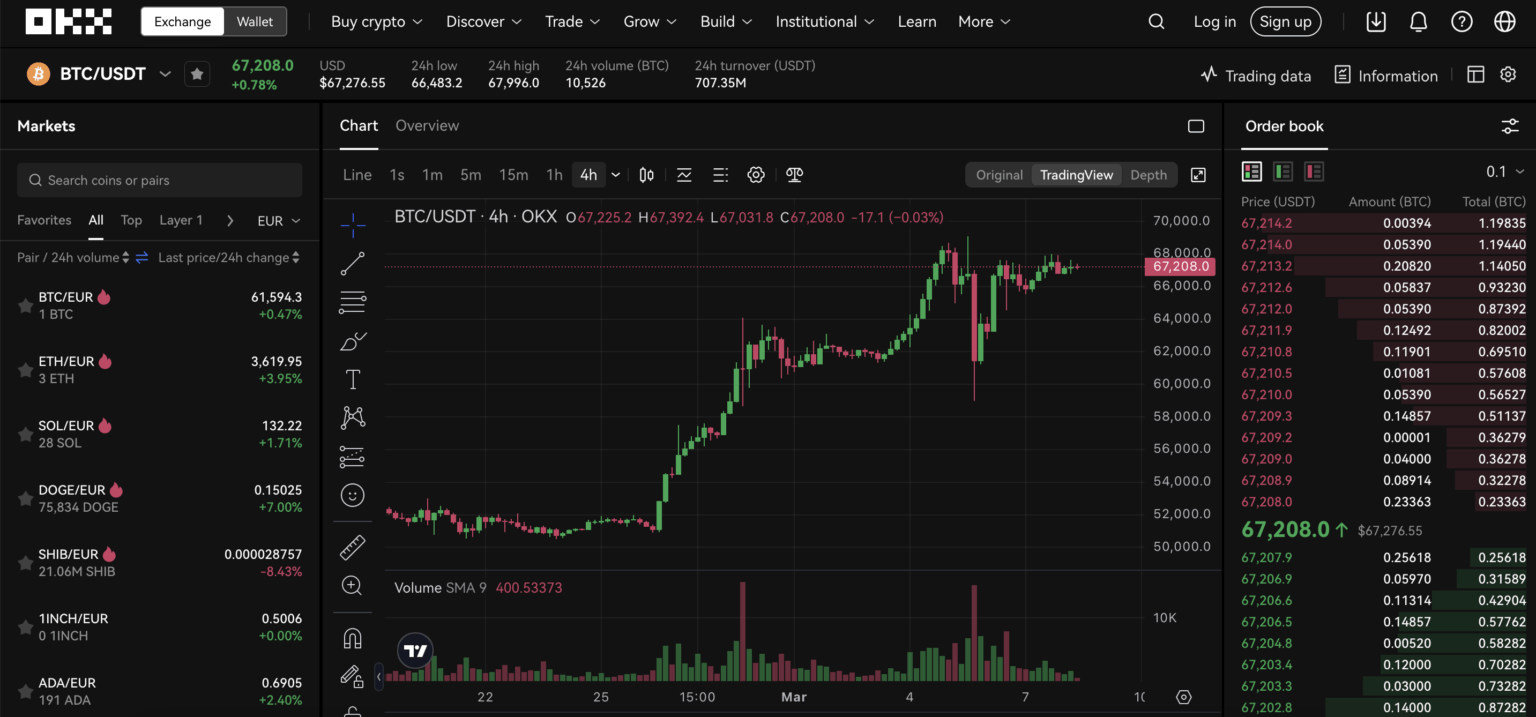
How OKX Login Works: mechanisms, controls, and the human layer
Mechanically, OKX combines centralized servers, web session tokens, and optional Web3 wallet connections. Account protection relies on KYC identity, strong encryption of credentials, and mandatory two-factor authentication (2FA): SMS, Google Authenticator, or biometrics. For U.S. users this also means a facial liveness check during KYC. Behind the scenes there is AI-driven real-time threat detection that flags anomalous IPs or login patterns and may force extra verification or session termination.
One important nuance: secure custody of assets and secure access to accounts are related but distinct problems. OKX stores over 95% of assets in cold, air-gapped multi-signature wallets and publishes Proof of Reserves so users can verify backing on-chain. That reduces systemic counterparty risk. But the point of exposure in many real loss cases is the account login or the withdrawal signing path: if an attacker gets past login controls, a multi-signature withdrawal process and cold storage approvals are a strong second line of defense, but they do not eliminate the possibility of account-level theft involving hot funds, margin positions, or token approvals executed while logged in.
Case: a U.S. trader’s sign-in choices and trade-offs
Imagine two traders: Alex is an active futures trader who needs rapid access and often uses margin. Jordan is a long-term holder who trades occasionally and prioritizes security. Their sign-in choices illustrate trade-offs.
Alex enables biometric mobile login for speed, uses Google Authenticator as a second factor, and keeps a small hot balance on the exchange for margin while storing the remainder in OKX cold custody or a hardware wallet. This setup lowers friction and keeps execution latency low, but it increases exposure if the mobile device is compromised or if Alex unintentionally enables an unsafe browser extension.
Jordan disables mobile biometrics for the exchange, uses a hardware 2FA device when available, and routes most funds to the non-custodial OKX Web3 wallet (self-custodial) or a Ledger/Trezor. Jordan accepts slower refill times when moving funds back to the exchange; the reward is less exposure to account takeover and phishing. Both choices are defensible, but they prioritize different risk budgets—speed versus custody control.
Where the system breaks: limits, common failure modes, and what to watch
There are predictable failure modes to plan around. Phishing remains the top operational threat: fake login pages or malicious browser extensions can capture credentials and session tokens. Social engineering tied to KYC or customer support can also trick users into revealing access. Smart-contract exploits matter when using DeFi products or the OKX DEX aggregator: approving a malicious spender can drain otherwise secure balances.
Another boundary condition is liquidity and leverage: OKX offers up to 125x leverage on select derivatives, and up to 10x on margin. High leverage amplifies execution speed needs and the cost of a single miscoded order; slippage and liquidity shortfalls on low-volume assets can turn a margin call into a liquidation within seconds. Login speed is therefore not just convenience for leveraged traders—it is a component of their risk model.
Practical steps for safer OKX sign in (U.S. trader checklist)
Below are operational heuristics you can apply immediately. They are simple, but disciplined application separates avoidable losses from unlucky outcomes.
– Use hardware 2FA or an authenticator app rather than SMS when possible; SMS is better than nothing but more vulnerable to SIM swap attacks. – Enable device-based biometrics only on personal, secured hardware; disable persistent “remember me” sessions on public or shared machines. – Keep hot balances minimal; treat the exchange as a gateway for execution and maintain the bulk of capital in cold custody or your self-custodial wallet. – Regularly audit browser extensions and use a separate browser profile for trading to lower the attack surface for malicious scripts. – Learn to verify Proof of Reserves checks periodically—on-chain transparency is powerful but requires the user to know what to verify.
Comparing OKX with similar options: trade-offs for U.S. users
Compare three archetypal choices: a full-service CEX like OKX, a decentralized-only workflow using wallets and DEXes, or a hybrid where you custody assets offline and deposit hot funds for trades.
– Full-service CEX (OKX): pros include advanced derivatives, deep liquidity across 300+ assets, integrated staking and NFT marketplace, and customer support with KYC-based services. Cons include custodial risk for hot balances and regulatory friction associated with KYC. – Decentralized workflow (wallet + DEX): pros are self-custody, direct interaction with DeFi primitives, and avoidance of KYC; cons include exposure to smart contract bugs, no chargebacks, and often inferior derivatives tooling. – Hybrid: keeps most assets in cold storage or a hardware wallet, uses OKX for execution when liquidity or advanced derivatives are required. The trade-off is operational complexity—moving funds back and forth costs time and gas—but it balances execution needs with custody safety.
If you need direct, step-by-step guidance for the sign-in process and the options described here, consult this practical walkthrough on how to approach an OKX sign-in safely: okx login.
What the recent ICE investment might mean for access and regulation
Recent reports this week noted a sizable strategic investment into OKX by a major global exchange operator. If such capital flows are accurate, the practical implications for U.S. traders are conditional: stronger institutional ties can mean improved compliance infrastructure, tighter integration with traditional market rails, and potentially more SRO-like oversight. That tends to reduce counterparty risk for retail customers. Conversely, deeper institutionalization often brings heavier KYC and regulatory transparency, which some privacy-focused traders view as a cost. This is not deterministic—watch for regulatory filings and product announcements rather than assuming immediate changes.
Decision-useful takeaway: a simple heuristic
Use this mental model when choosing how to sign in and operate: match login friction to risk exposure. If you keep large or slow-moving holdings, accept higher friction (hardware 2FA, cold custody). If you need low latency for high-leverage trading, accept higher operational risk but mitigate it with disciplined hot-wallet sizing, a separate trading device, and continuous monitoring. The ratio of hot balance to total portfolio is the clearest lever you control.
FAQ
Q: Is OKX safe to use in the U.S. given KYC and Proof of Reserves?
A: “Safe” is contextual. OKX implements strong institutional controls—Proof of Reserves, >95% cold storage, multi-signature withdrawal approvals, and AI threat detection—which lower exchange-level counterparty risk. However, user-level risks (phishing, poor 2FA hygiene, malicious approvals) remain. For large balances, the safer profile is custody outside hot exchange wallets with periodic, planned deposits for trading.
Q: What is the fastest secure way to sign into OKX for frequent derivatives traders?
A: A practical combination is a secured personal device with biometric unlocking, an authenticator app (not SMS) for 2FA, and a small hot balance dedicated to margin. Complement this with a dedicated browser profile or device used only for trading to limit exposure to malicious extensions.
Q: How should I balance custody, speed, and regulatory transparency?
A: Think in buckets: cold custody (long-term, low friction), hot custody (execution, small size), and on-exchange margin (short-term, high-speed). Regulatory transparency is the price of certain services—if you want fiat rails and institutional-grade derivatives, expect KYC. If you need privacy, be prepared for the trade-off of reduced services and increased personal responsibility.
Q: Can OKX’s DEX aggregator replace centralized order routing?
A: The DEX aggregator can find efficient on-chain routes and cross-chain swaps, but it won’t match CEX features for derivatives, deep order books, or ultra-low-latency execution. For spot swaps and cross-chain moves it is powerful; for leveraged trading it is complementary, not a replacement.